Culture and traditions
Cortina is not just sport, glamor and elegance. Within the secular culture that distinguishes it in fact, the locality has managed to preserve and preserve over time traditions that have disappeared elsewhere, which in an almost amazing way continue to coexist with the more contemporary aspects of modern culture.
The traditions of the Ampezzo Valley have their origins in a simple and essential life: the daily reality of a mountain valley, in an environment as fascinating as it is severe, has taught us to give importance to everything that creates sharing, mutual help and sense of belonging.
There are about 35,000 Ladins who live in five valleys that have the Sella massif as their natural center: Val Badia, Val Gardena, Val di Fassa, Livinallongo del Col di Lana, Colle Santa Lucia and Cortina d'Ampezzo.
This population speaks a language of very ancient origin, Ladin, which takes on local varieties in the various valleys.
Anpezo no n’ é solo sport, sciorarìa e biei sarvijie. Pede a ra cultura del popol portada inaante dal vecio in fora inze i secui, se ś’é śude adora a precurà e tiegnì al seguro ra tradizios che da outra bandes no n’é pì e che se resta de stuco a se pensà che es seguita a śì inaante e che es vive aduna a ra cultura moderna.
Ra tradizios de ra Val de Anpezo es rua da ’na vita zenza jeste e poereta: ra vita de dute i dis de ‘na val inze meso a ra crodes, inze un anbiente tanto da toi el fiado cuanto duro da vive, l à insegnà a dà valor a duto chel che fesc comunità, el stà aduna e se dià ‘na man un con l outro.
I Ladis i é supośò 35.000 e i vive inze ra zinche valades intor el Sela: Val Badia, Val Gardena, Fascia, Fodom, Col e Anpezo.
Chesto popol el parla el ladin,‘na parlada stradelà de vecia, che ra no n’é conpagna inze ogni valada.
Approfondimenti


Luoghi
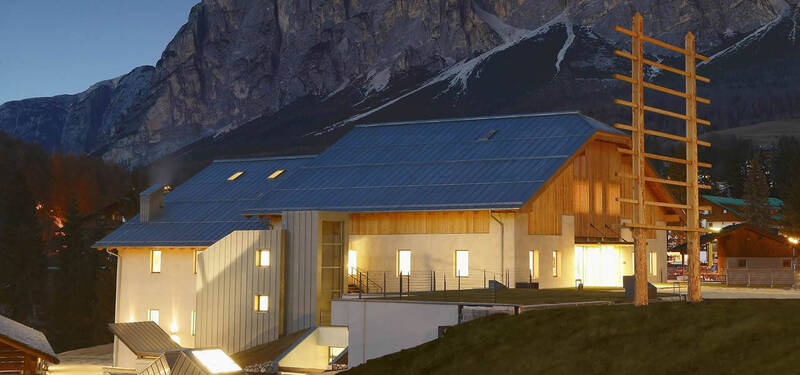
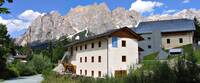
Alexander Girardi Hall
Multifunctional structure dedicated to Alexander Girardi, a singer and actor of the Viennese operetta of the late nineteenth century, who was born in Graz from a father of Ampezzo origin.
Alpine church of Pian de ra Costaza (Vervei)
In the list of Ampezzo’s churches, it is the latest to arrive: it was inaugurated on 3 September 2000, in the year of the great Jubilee.
Cemetery Chapel
The current cemetery has a small chapel on its south side connected to the surrounding wall.
Chapel at the Tre Croci (Three Crosses) Pass
The chapel stands on the short flat stretch of the saddle of Passo Tre Croci and is flanked by three simple wooden crosses.
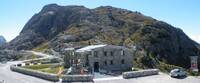
Chapel of the Military Memorial in Pocol
On the Pocol hill, which dominates the Ampezzo valley from the south-west, the Italian soldiers who died during the First World War were buried between 1915 and 1917, in the strenuous conquest of the Castelletto and the breaking through of the Austrian line between the Tofane and Lagazuoi.
Chapel of the Visitation at the Falzarego Pass
In 1958, the Andreis of Trento, who managed the hotel on the Pass, promoted the construction of a simple white church with a gabled roof.
Church of Most Holy Trinity to Majon
The events of the elegant Majon chapel are linked to those of the de Zanna family: in fact, it stands close to one of the perimeter towers of the castle that Giovanni Maria de Zanna attempted to erect starting in 1700.
Church of San Candido in Campo di Sopra
The chapel of San Candido was built in the first half of the eighteenth century as a vow of the Ampezzo village of Campo di Sopra against the fires that had destroyed it several times.
Church of San Francesco in San Francesco’s small square
The small church of S. Francesco is owned by the Constantini family.
Church of San Nicolò, San Biagio and Sant’Antonio Abate in Ospitale
The small church of Ospitale was built in 1226 on the northern border of the territory of Ampezzo.
Church of San Rocco in Zuel di Sopra
The church is dedicated to Saint Rocco of Montpellier, revered for healings from the plague.
Church of Sant’Andrea a Col
A document dated 1671 remembers the will of Francesco Colli d'Ampezzo, a Franciscan father, to erect a chapel in the hamlet of Col to be able to place some precious relics received as a gift in 1668 by the Bishop of Bergamo.